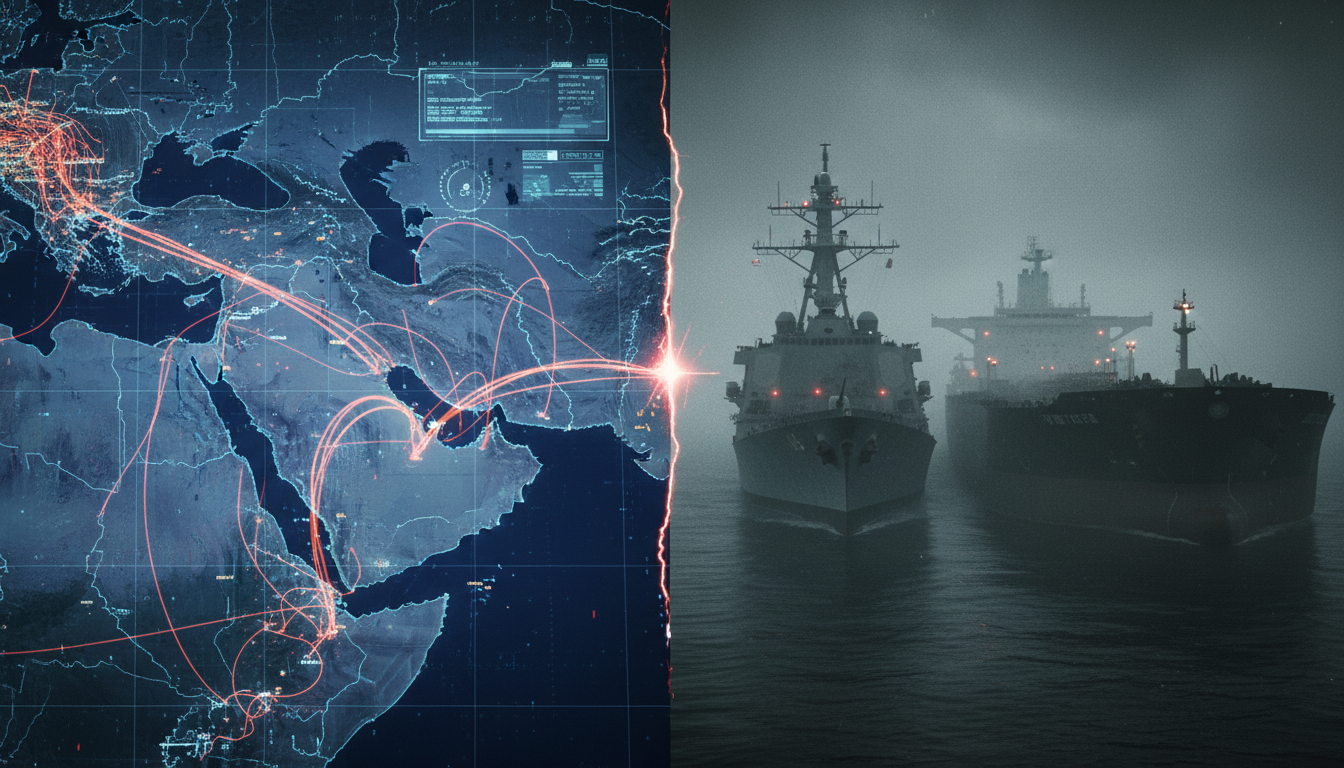
Ship Signals Erratic as Hormuz Tensions Escalate
Electronic warfare and 'Project Freedom' push oil to $114 as the Strait of Hormuz becomes a maritime black box.
Christian Rosenblum
Managing Editor
Key Takeaways
- Oil prices have surged past $114/bbl following the breakdown of the April ceasefire.
- GNSS spoofing and AIS jamming are causing ships to appear inland or at impossible speeds.
- The U.S. has launched 'Project Freedom,' a major naval escort mission involving 15,000 personnel.
- A 600% increase in 'dark shipping' (transponders off) is significantly raising collision risks.
- The UAE's defensive electronic warfare systems are inadvertently contributing to the 'signal fog.'
The Electronic Fog of War Descends on the Strait
In the last 24 hours, the Strait of Hormuz has transformed from a vital maritime artery into a digital 'black box.' Data from Starboard Maritime Intelligence and Windward AI reveal a surreal scene: commercial tankers appearing to travel at 100 knots over the Omani mountains, while others cluster inexplicably inland near Abu Dhabi. This is the 'Electronic Fog of War,' and for energy investors, it signals a dangerous new phase in global volatility.
As of May 11, 2026, the fragile April ceasefire is essentially dead. Iranian forces have reportedly launched fresh drone and missile strikes, while the United Arab Emirates has activated its high-end electronic warfare suites. The result is a chaotic saturation of GNSS spoofing and AIS jamming that makes traditional maritime tracking nearly impossible.
Project Freedom: The U.S. Response
Under the Trump administration, the United States has officially launched "Project Freedom." This isn't just a monitoring mission; it’s a massive deployment of 15,000 personnel and over 100 aircraft designed to provide active naval escorts for commercial vessels. President Trump has framed the move as a 'humanitarian rescue' for stranded seafarers, but Tehran views it as a direct violation of the regional status quo.
The stakes couldn't be higher. Over 20% of the world's seaborne oil passes through this 21-mile-wide chokepoint. With shipping lanes effectively blinded, Brent crude has already spiked above $114 per barrel.
Vessels Caught in the Crossfire
While most of the fleet is hesitant, a few daring vessels are attempting the transit. The Agios Fanourios I, a VLCC (Very Large Crude Carrier) loaded with Iraqi oil, and the tanker Stella are currently attempting to navigate the strait 'dark'—with their transponders completely off. According to the UKMTO, this 'dark shipping' has increased by 600% this month, exponentially raising the risk of accidental collisions or lethal miscalculations by jittery naval batteries.
Fox Energy’s Take: What Investors Need to Know
At Fox Energy, we’ve always said that energy security is national security. This isn't just a localized skirmish; it is a fundamental disruption of the global supply chain. If the electronic interference continues to spread, the 'insurance premium' on every barrel of oil leaving the Gulf will continue to climb. Investors should be prepared for sustained volatility as the market price-in the possibility of a full-scale naval engagement between U.S. forces and Iranian coastal batteries.
"We are seeing a convergence of kinetic warfare and digital deception. When ships start 'flying' over deserts on our tracking screens, we know the traditional rules of the game are gone." — Christian Rosenblum, Managing Editor
Sources: Starboard Maritime Intelligence, Windward AI, UKMTO (United Kingdom Maritime Trade Operations) May 10-11 Incident Reports, White House Press Briefing on Project Freedom.
Frequently Asked Questions
What is GNSS spoofing and why is it happening?
GNSS spoofing involves sending false satellite signals to a ship's receiver. It is being used by both aggressors and defenders in the region to confuse targeting systems and maritime surveillance, effectively creating 'phantom' vessels on tracking maps.
Is the Strait of Hormuz currently closed?
While not physically blocked, the combination of kinetic attacks and electronic warfare has made the passage extremely dangerous. Most commercial traffic has slowed, and those that proceed are often doing so without tracking signals.
What is the goal of Project Freedom?
Launched by the U.S. under the Trump administration, Project Freedom aims to provide active military escort to commercial vessels to ensure the continued flow of global oil supplies despite Iranian threats.
Christian Rosenblum
Managing Editor