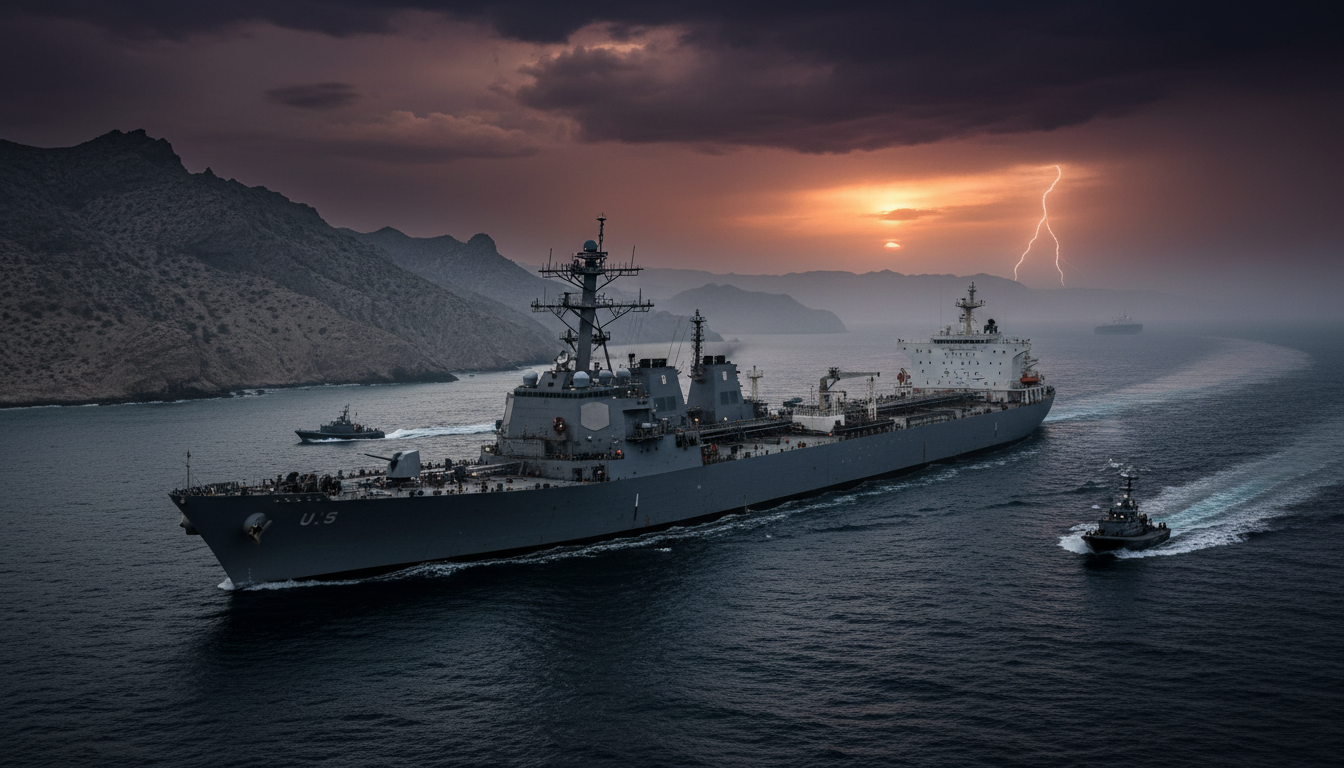
Shipping Freeze Deepens: Strait of Hormuz Crisis Enters High-Stakes Escalation Phase
As U.S. 'Operation Project Freedom' launches, global energy markets brace for a protracted dual blockade and record-high insurance premiums.
Christian Rosenblum
Managing Editor
Key Takeaways
- Brent crude has peaked at $126/barrel due to the 'dual blockade' in the Strait of Hormuz.
- Operation Project Freedom has deployed 15,000 U.S. personnel, but commercial insurance remains unavailable.
- Non-oil impacts include a 32% spike in fertilizer prices and a 100% surge in helium costs.
- The Red Sea remains high-risk, leaving no viable 'Suez shortcut' for trapped Gulf exports.
The geopolitical standoff in the Middle East has reached a fever pitch as the "shipping freeze" in the Strait of Hormuz enters its most volatile phase yet. As of May 5, 2026, what began as a tactical blockade has transformed into a direct military and economic confrontation between the United States and Iran, leaving roughly 20% of the world’s oil supply and 25% of seaborne LNG in a state of suspended animation.
Operation Project Freedom vs. The IRGC Control Zones
In response to the total paralysis of the world’s most vital energy chokepoint, the Trump administration has greenlit Operation Project Freedom. U.S. Central Command (CENTCOM) has deployed a massive force—15,000 personnel and over 100 aircraft—to provide armed escorts for commercial vessels. However, the Islamic Revolutionary Guard Corps (IRGC) has met this move by expanding its "control zones" to the borders of the UAE, utilizing sophisticated drone swarms and naval mines to maintain its grip on the waterway.
The Dual Blockade: A Two-Sided Squeeze
Investors must understand that this is no longer a one-sided disruption. We are currently witnessing a dual blockade. While Iran prevents exports from leaving the Persian Gulf, the U.S. Navy has effectively blockaded Iranian ports since mid-April to choke off Tehran’s own oil revenue. This mutual strangulation has left the global market in a supply vacuum that domestic production is struggling to fill.
The 'War-Risk' Insurance Vacuum
Perhaps the greatest hurdle to resuming normal trade isn't just the physical threat of drones—it’s the lack of financial coverage. Major P&I clubs and maritime insurers have entirely withdrawn "War-Risk" insurance for the region. Even with U.S. Navy escorts available for vessels like the Alliance Fairfax, the majority of the global fleet owned by giants like Maersk and Hapag-Lloyd remains idle or rerouted around the Cape of Good Hope. Without insurance, a commercial transit is a total capital risk that most boards are unwilling to take.
Beyond Oil: The Cascading Economic Fallout
While the focus remains on Brent crude peaking at $126 and U.S. gasoline hitting $4.30 per gallon, the crisis is bleeding into other critical sectors:
- Agriculture: Fertilizer (urea) prices have spiked 32%, threatening the next global harvest cycle.
- Technology: Helium prices—critical for semiconductor manufacturing—have surged by up to 100% as Gulf-based production remains trapped.
- Humanitarian: The International Maritime Organization (IMO) reports that nearly 20,000 seafarers are currently "locked up" on stranded vessels, creating a brewing human rights crisis.
At Fox Energy, we are closely monitoring the diplomatic backchannels in Pakistan, but the death of the April ceasefire suggests that a military resolution or a prolonged economic winter may be the only paths forward. For the accredited investor, this volatility underscores the necessity of diversified energy plays and a keen eye on domestic supply chain infrastructure.
Trust Block: Fox Energy provides high-level analysis for accredited investors, focusing on the intersection of geopolitical risk and energy market volatility. Our reports are vetted by industry veterans to ensure institutional-grade insights.
Source Block: Data for this report was synthesized from U.S. Central Command (CENTCOM) briefings, International Maritime Organization (IMO) vessel tracking, and real-time market data from the Fujairah oil hub.
Frequently Asked Questions
What is the 'Dual Blockade'?
Why aren't U.S. military escorts enough to resume shipping?
Christian Rosenblum
Managing Editor