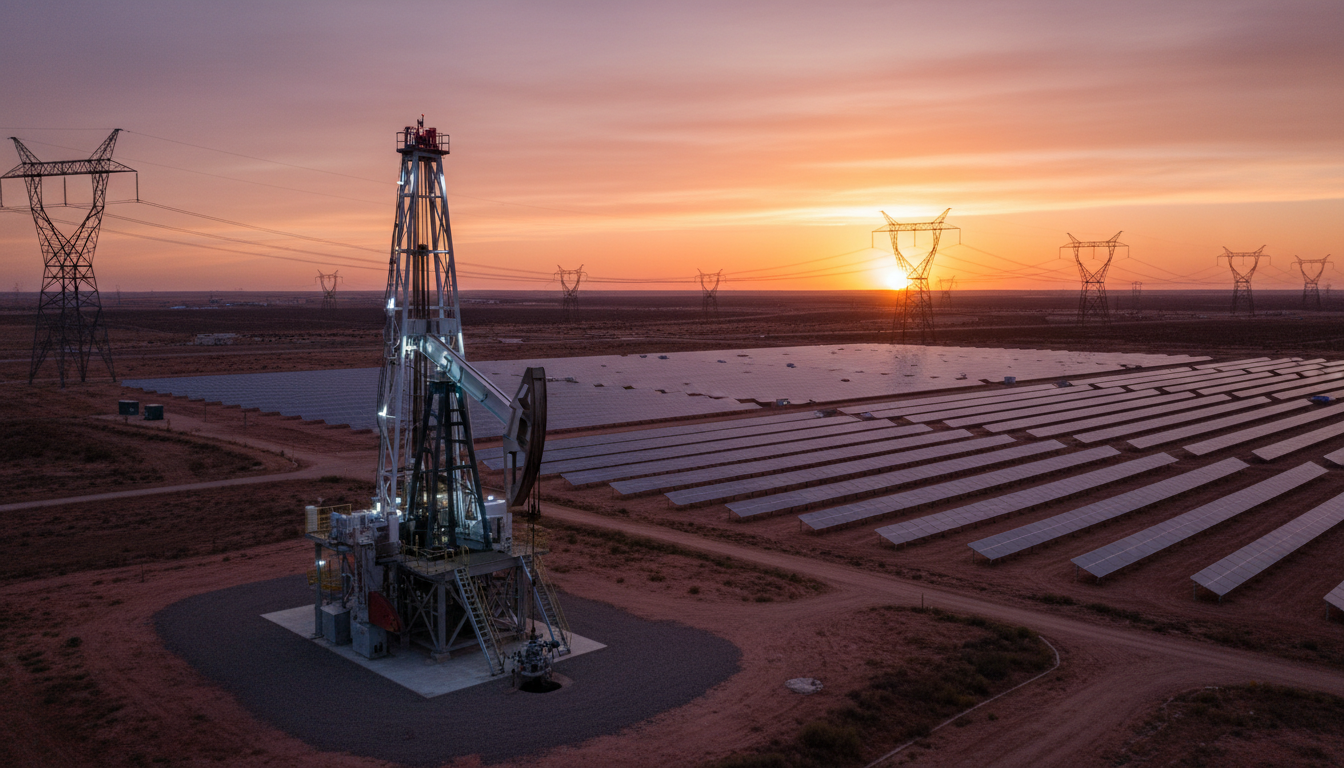
The United States Set Record Energy Production in 2025, Again
13.6 million barrels per day, 50 GW of new renewables, and a grid pushed to the limit by Big Tech: Inside the 2025 energy records.
Christian Rosenblum
Managing Editor
Key Takeaways
- U.S. total energy production hit a record 107 quadrillion BTUs in 2025.
- Crude oil production reached 13.6 million b/d despite a 5% decrease in active rigs.
- The Permian Basin continues to dominate, providing nearly half of all U.S. crude.
- Electricity generation hit 4,430 TWh, driven largely by AI and data center expansion.
- Renewables now account for 17% of total generation, with 50 GW added in 2025 alone.
For the fourth consecutive year, the United States has solidified its role as a global energy superpower. According to the latest year-end data from the U.S. Energy Information Administration (EIA), total domestic energy production reached a staggering 107 quadrillion British thermal units (quads) in 2025. This milestone isn't just a number; it represents a fundamental structural shift in how the world's largest economy powers itself and its allies.
The Permian Engine and the Efficiency Paradox
The headline figure of 2025 is the record-breaking crude oil production of 13.6 million barrels per day (b/d). What makes this record particularly notable for investors is the "Efficiency Paradox." Despite lower average crude prices ($65/bbl) and a 5% reduction in active rig counts compared to 2024, production continued to climb. This was driven by technological productivity: longer laterals, optimized fracking recipes, and better reservoir management in the Permian Basin, which alone accounted for 48% of total U.S. crude output.
While the Permian remains the "engine," the Bakken and Eagle Ford regions showed remarkable resilience, contributing steady volumes that offset natural declines elsewhere. For those looking at energy investment opportunities, the lesson of 2025 is clear: the U.S. shale industry has mastered the art of doing more with less.
The Three Pillars of Demand: AI, Manufacturing, and Electrification
For the first time in decades, the U.S. is facing a sustained surge in electricity demand. Total generation hit 4,430 TWh in 2025, fueled by what we call "The Three Pillars":
- AI and Data Centers: The rapid build-out of hyperscale data centers by Big Tech has turned electricity into a premium commodity.
- Industrial Manufacturing: A resurgence in domestic chip making and battery production is adding significant load to the grid.
- Electrification: The continued transition of heating and transport is pushing the grid to its limits.
Renewables have stepped up to meet a portion of this demand. In 2025, the American Clean Power Association (ACP) reported a record 50 GW of wind, solar, and battery storage additions. Remarkably, in March 2025, fossil fuels provided less than half of the nation's monthly power for the first time in history, though natural gas remains the essential reliability partner for the grid.
Policy, Infrastructure, and the Path Forward
The regulatory landscape in 2025 was defined by the "One Big Beautiful Bill Act," which aimed to streamline energy permitting and provide long-term certainty for both traditional and renewable projects. Under the guidance of the Department of Energy and Secretary Wright, there has been a concerted effort to refill the Strategic Petroleum Reserve (SPR) while positioning the U.S. as the world's leading LNG supplier. With plans to double LNG exports by 2030, the U.S. is using energy as a primary tool of national security.
However, challenges remain. Infrastructure constraints, particularly in the national grid, pose a risk to the 2.8% annual growth in demand. Investors must keep a close eye on the "breakeven" costs for domestic producers. If global supply surpluses continue to weigh on prices, capital discipline will be tested in 2026 and 2027.
Frequently Asked Questions
How did oil production increase while the rig count fell?
This is due to significant gains in drilling efficiency. Operators are using longer lateral sections and more advanced hydraulic fracturing techniques, allowing them to extract more oil per well even as they reduce the total number of active rigs.
What role did AI play in 2025 energy records?
AI and data centers have become a primary driver of electricity demand. The massive power requirements for training and running large language models contributed to the record 4,430 TWh of total generation in 2025.
Is the U.S. still the world's largest LNG exporter?
Yes. As of 2025, the U.S. has maintained its position as the top global LNG supplier, with infrastructure projects underway to double export capacity by 2030 to meet international demand.
Christian Rosenblum
Managing Editor